Water Line Repair & Replacement
Fix or renew the supply pipe running from the street meter to your house, including trenchless options.
The shower dribbles, the bathroom sink takes a minute to fill a glass, or the whole house went weak overnight. Pressure trouble has a short list of causes, and the pattern of which taps are weak usually narrows it fast.
No water at all is different. Check the main valve, then phone the line and say how long it has been off.
Open a bathroom tap, a kitchen tap and an outdoor hose bib one after another. A weak result at one fixture points to that fixture. A weak result at all three points to the supply side of the house.
Write down when it started. A sudden drop after plumbing work suggests a valve left partly shut. A slow decline over months suggests scale or corroded pipe.
Unscrew the faucet aerator and look for grit or white crust. Soak it in vinegar, rinse it and screw it back on. Do the same with the showerhead.
Then confirm the main shutoff is fully open. A gate valve nudged half closed after a repair can cut flow to the whole house without any other sign.
The fix can be a ten-minute cleaning or a pipe replacement, so the quote depends on the cause. Four things matter most.
Ask for the gauge reading before and after the repair, so you can see what changed.
The City of Mesa 2025 water quality report describes hard water across the service area. Minerals build up inside fixtures, water heaters and older steel pipe, and that slowly shrinks the opening water has to pass through.
Many Mesa homes sit on concrete slabs, so a leaking supply line may run under the floor with no wet patch to see. A meter that keeps moving with every tap off is the clue to look for.
A pressure regulator that has aged out, a pinhole leak on a supply run or a split service line all reduce what reaches your taps. None of these show up from a faucet check.
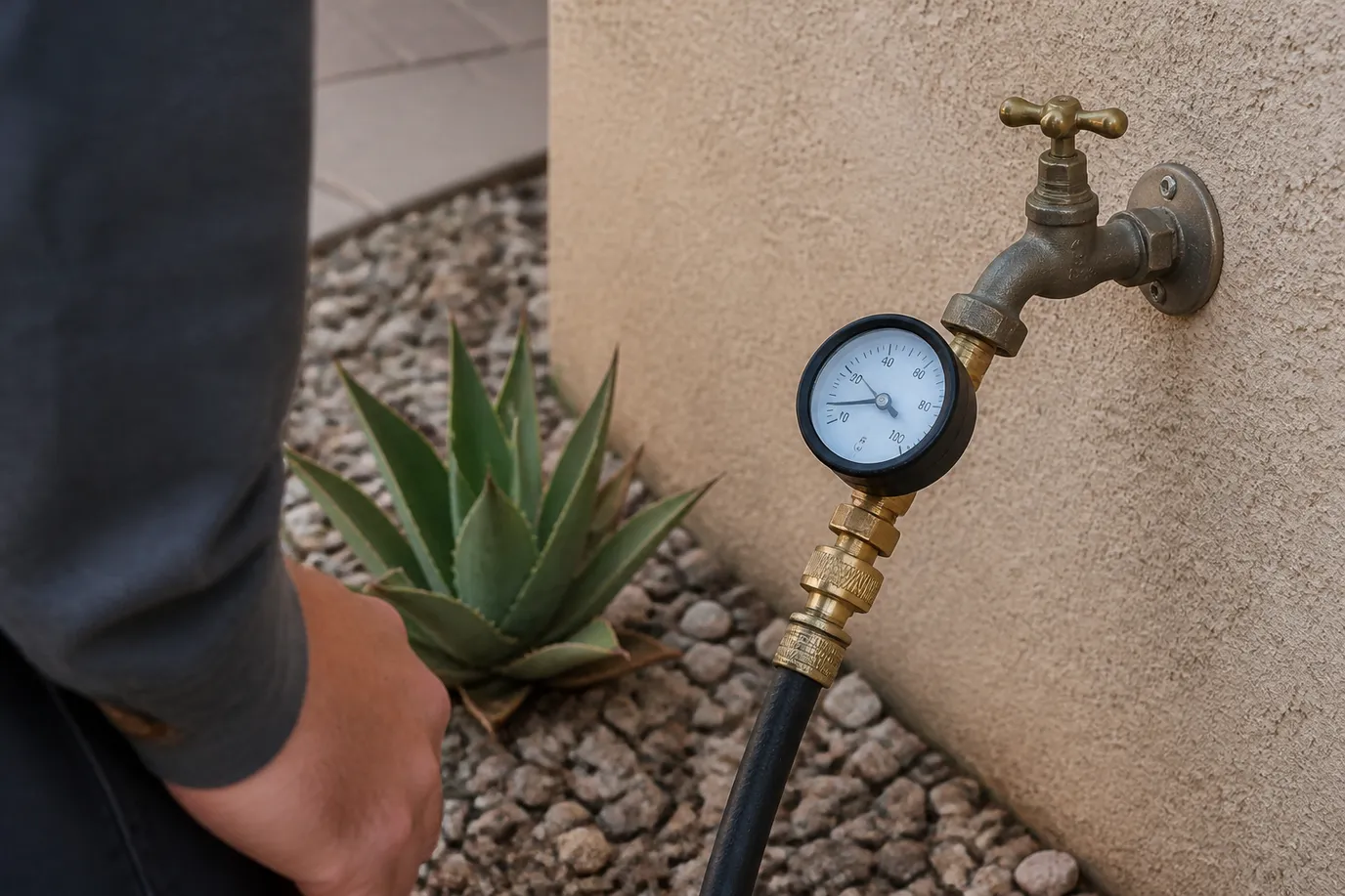
A plumber reads the pressure with a gauge on a hose bib, then follows the drop back toward the source. That reading is the single most useful number in the whole visit.
Weak flow rarely happens all at once. These patterns help you describe it clearly on the phone.
A plumber starts by screwing a gauge onto an outdoor hose bib. Static pressure with everything off tells you what the supply delivers. Running pressure with a tap open shows how much it falls under demand.
Model plumbing codes treat 80 psi as the upper limit for a house supply, and many homeowners prefer a range around 40 to 60 psi for comfort. A low static reading sends the search toward the regulator, the main valve or the street side. A normal static reading that collapses under flow sends it toward restricted pipe.
The plumber then compares pressure at the hose bib, at the water heater and at the weak fixture. The spot where the number falls hardest is where the restriction or leak sits. That keeps the work targeted instead of replacing parts by guess.
Hard water leaves mineral crust in aerators, showerheads, tankless heaters and the inside of older steel lines. Cleaning a fixture is cheap. A pipe narrowed along its whole length is a different job, and it is covered on the repiping page.
Regulators wear with age and mineral exposure. A failing one can leave pressure too low, or let it creep too high. Either reading is worth checking with a gauge before anyone replaces the part.
Many Mesa houses are built on slabs, so a supply leak can sit under the floor for weeks. If the meter moves while every tap is off, start with leak detection rather than hunting for a faucet fault.
A few minutes of checking makes the call more useful and sometimes solves the problem.
The cost of fixing low pressure ranges from nearly nothing for a cleaned aerator to a larger quote for pipe replacement. No flat figure applies, because the cause decides the work. Ask for the gauge readings and a written description of the fix before agreeing.
Weak flow on its own is usually a scheduled visit. Water that stops completely, or a leak that is spreading, deserves a call to the all-hours line. Same-day arrival depends on the contractor's schedule and cannot be promised from this page.
A regulator or valve is a modest repair, and replacing it often restores flow in a single visit. Pipe that has narrowed or pitted from the inside rarely recovers with cleaning. Past a certain point, new pipe is a fairer use of money than repeated service calls.
Ask the plumber to show you where the restriction is and what it will take to remove it. Compare a spot repair with a larger replacement before you decide, and ask how long each is expected to last.
Some callers describe weak flow when the real problem is no water. If every tap is dry, check the main valve and ask neighbors whether service is out. Then phone the line and report how long it has been off.
If only the hot side is weak, the water heater may be at fault. See water heater repair for that path, or water line repair when the supply pipe itself is suspect.
Fix or renew the supply pipe running from the street meter to your house, including trenchless options.
Locate hidden water loss behind walls, under floors or along the buried pipe, then decide how small an opening can be.
Swap aging galvanized, pitted copper or brittle early plastic lines for new pipe throughout the home.
A sudden drop usually means a valve is partly shut, a regulator failed or a supply line is leaking. Check the main shutoff first, then compare a few taps.
Look at the water heater shutoff and the hot side of the fixture. Scale in the heater or a half-open valve often cuts hot flow while cold stays normal.
Yes. Water escaping from a supply line is water that never reaches your taps. If the meter moves with every fixture off, a leak is the first suspect.
No. Weak flow can wait for a scheduled visit unless a leak is involved. A house with no water at all is urgent, so phone the line.
Yes, when every tap runs dry or a leak is spreading. Close the main valve if water is escaping, then call the overnight line and say how long the supply has been off.
Many homes run comfortably between about 40 and 60 psi. Model codes cap supply pressure at 80 psi. A gauge on a hose bib gives your actual number.
Over time it can. Mineral crust narrows aerators, showerheads and old steel pipe, which cuts flow even when the supply is healthy.
It depends on the cause. A cleaned fixture costs little, while a regulator swap or pipe replacement costs more. Ask for the gauge reading and a written quote.
It depends on the contractor's schedule. Call the line and say whether the water is merely weak or completely off.
Only after a gauge reading shows a problem. A regulator that reads far outside the normal range is worth replacing, and one that reads normal is not.
Usually not on its own. Treat it as urgent if the water stops entirely, if a leak is spreading or if the meter races with every tap off.
Say which taps are affected and when it began. The dispatcher uses that to match the right contractor.
Service area centered on Mesa and nearby Maricopa County cities.